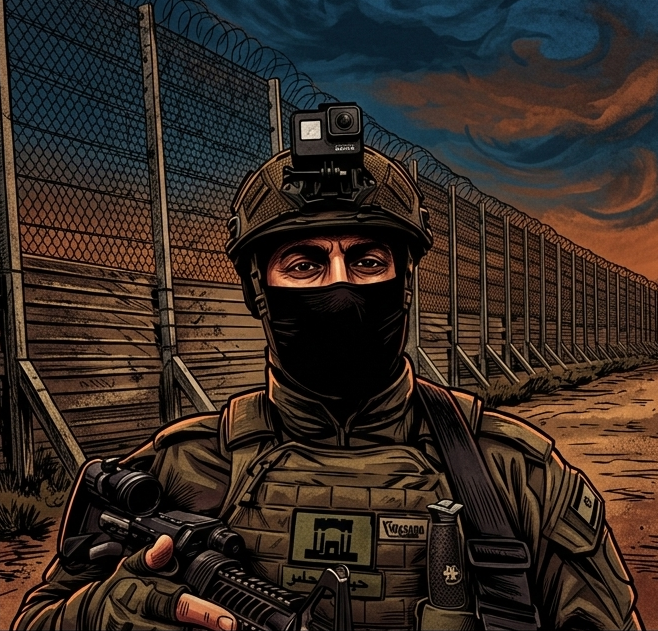
This image was created using Gemini 3 Flash, specifically powered by the Nano Banana 2 image generation model (officially known as Gemini 3.1 Flash Image). This digital illustration is an AI-generated conceptual of an Israeli military officer fighting in Gaza saying that the goal of the war in Gaza is to build the Temple Mount over Al-Aqsa Mosque. Source:@ytirawi
The legacy of Meir Kahane, the radical rabbi assassinated in 1990, was once a pariah element in Israeli politics. Today, that shadow has lengthened into a dominant reality. Kahanism has migrated from the extremist fringe to the very heart of the Israeli government, threatening to dismantle the country’s democratic foundations from within. Kahane’s “Jewish Defence League” and the later “Kach” party were built on a foundation of “Jewish Power” and the forced “transfer” of Arabs - ideologies so toxic they were once banned from the Knesset. Yet, three decades later, the slogan Kahane Tzedek (“Kahane was right”) litters social media, and his disciples now hold the levers of the state.
The most visceral evidence of this shift is Itamar Ben-Gvir. Once a youth activist in the illegal Kach movement, he now serves as the Minister of National Security, overseeing the nation’s police. Alongside Finance Minister Bezalel Smotrich, Ben-Gvir represents a messianic settler movement that views the Israeli state not as a secular democracy, but as a vessel for a supremacist, theocratic mission. Under their influence, the line between the military and the settlers has effectively vanished. In the West Bank, “settler-soldiers” in reserve units now operate alongside armed civilian militias to police Palestinian communities, creating a symbiotic relationship where it is no longer clear where the army ends and the vigilante begins.
Long before the current war, Israel was already fracturing. Netanyahu, weakened by corruption trials and desperate for political survival, tethered his fate to these extremists. This alliance sparked months of unprecedented domestic protests, with President Isaac Herzog warning that the country was staring into the “abyss” of civil war. While the October 7 massacre briefly forced a surface-level unity, that cohesion is rapidly disintegrating. Netanyahu is widely accused of sabotaging hostage deals and prolonging regional conflict to stave off a prison sentence, effectively holding the nation’s security hostage to his personal legal woes.
The most alarming sign of this institutional decay occurred at the Sde Teiman military base in July 2024. When military police attempted to arrest reservists suspected of the horrific abuse of a Palestinian detainee, far-right lawmakers and masked mobs - including off-duty soldiers - stormed the facility to demand their release. This breakdown of discipline suggests that the Israeli army’s ideological fractures are reaching a dangerous point. If a future government were to attempt a withdrawal from the West Bank or propose a genuine peace deal, the well-armed, Kahanist-influenced units within the security forces might violently resist the state itself.
Since the October 7 attacks, this radicalisation has accelerated. Over 800 “civilian defence squads” have been established with minimal vetting, effectively arming a partisan base. Inside the ranks fighting in Gaza, religious-nationalist fervour is on open display; soldiers have been filmed wearing “Third Temple” patches - a direct reference to the extremist desire to destroy the Al-Aqsa Mosque - and raising flags of dismantled settlements, signalling an intent for permanent “Judaisation” through ethnic cleansing. This is no longer just a war against Hamas; for the Kahanist wing, it is an opportunity to rewrite the map of the Middle East. Lebanon and Syria are in their sights as they dream of a ‘Greater Israel’ stretching across the region.
Though very distinct from ISIS, the Kahanist project shares a similar blueprint of apocalyptic carnage, ethnic cleansing, and a religious hunger for land - swapping a “dramatic flair” for beheading and crucifixions for the machinery of a modern army.
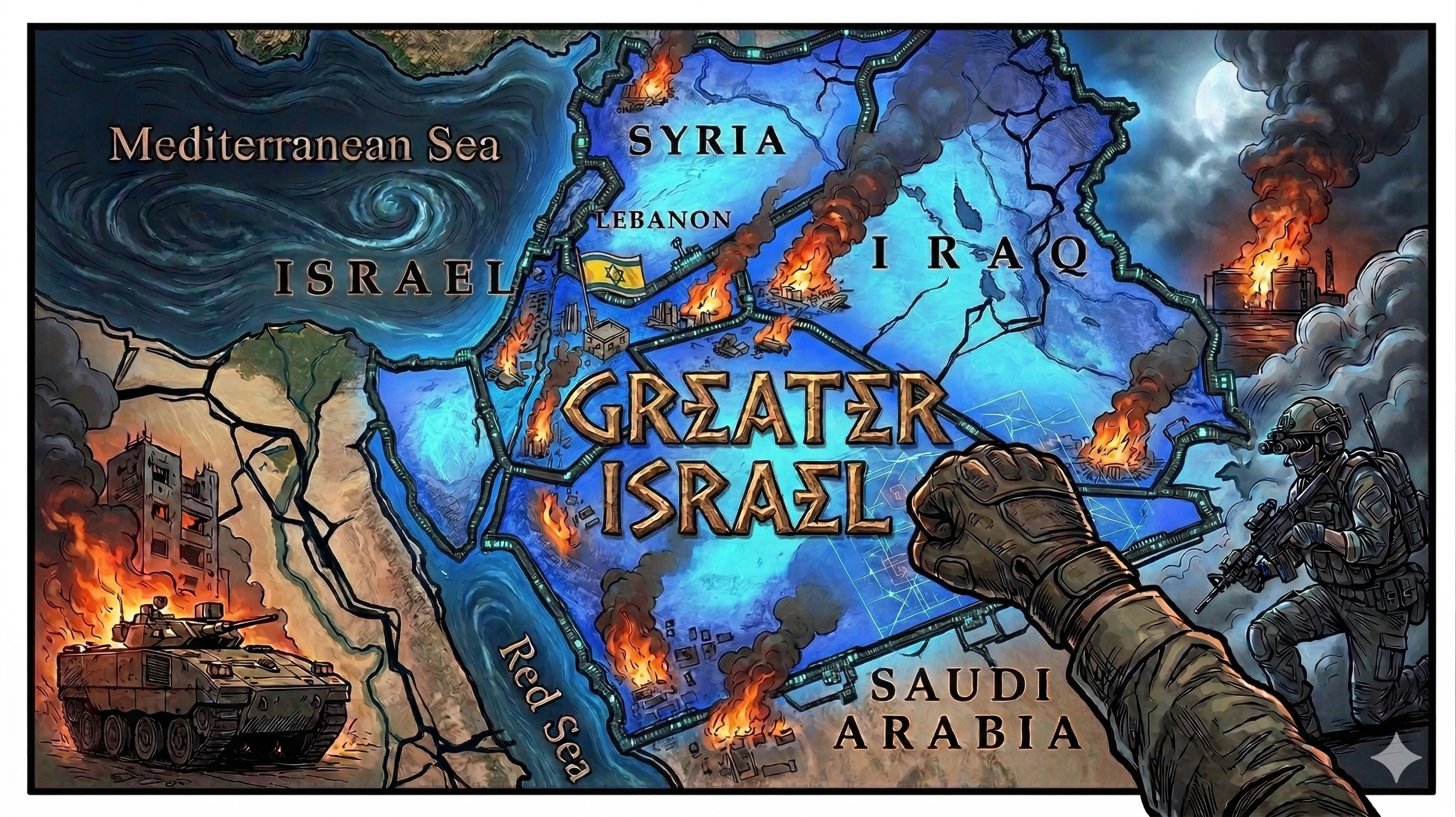
This image was created using Gemini 3 Flash, specifically powered by the Nano Banana 2 image generation model (officially known as Gemini 3.1 Flash Image). This digital illustration is an AI-generated conceptual map depicting a "Greater Israel" territorial expansion.
This expansionist tide is already carving new borders. The Israeli army annexed the Golan Heights in 1967 and seized swathes of southern Syria in 2023 following the fall of Bashar al-Assad. From southern Lebanon and Syria to the whole of Gaza and the West Bank, military occupation persists by air, land, and sea. These extremist ambitions for total annexation now mirror Putin’s campaign in Eastern Ukraine and Crimea. Across a landscape of shattered nations - Palestine, Lebanon, Iraq, Yemen, and Syria - Israel maintains the status quo, operating at the eye of a storm as the United States helps it sustain its war machine. For the architects of this “cauldronised” Middle East, it is better to face a divided land than equals or united enemies.
In Iran, a brutal theocratic regime that has fuelled its own proxy wars in a quest for regional domination, Netanyahu harbours similar ambitions as he wages war on the country alongside the United States. The Israeli Prime Minister cares little for the Iranian people; he seeks only a collapsed state torn by civil strife and instability, regardless of the consequences such dire scenarios hold for the region, the wider world, and Israelis themselves.
Netanyahu and his cadre of fanatics are no less dangerous than the hardliners within the Iranian regime or the Islamic Revolutionary Guard Corps. While Tehran has slaughtered thousands of its own citizens and exported chaos across the region - butchering tens of thousands from Beirut to Baghdad and propping up the Assad regime’s industrial-scale massacres - Netanyahu’s government has matched this brutality in a fraction of the time. In just three years, his ‘regime’ has laid waste to Gaza and the West Bank through acts of genocide and ethnic cleansing, while simultaneously obliterating swathes of Lebanon, Yemen, Iran, and Syria in a campaign of unchecked crimes against humanity and war crimes. If Iran’s theocracy is the fire of regional instability, Israel’s apartheid state is the tinder and the match.
Like Slobodan Milošević before him, who dismantled Yugoslavia to embolden the extremists dreaming of a “Greater Serbia,” Netanyahu feeds on the wreckage of the Middle East. He finds his mirror in Donald Trump: a man governed by the instant gratification of the screen and the whispers of flatterers. They are perfect bedmates in Trump’s idiocracy. Together, they lurch from crisis to crisis to stave off the inevitable - Netanyahu delaying the reckoning for the October 7 failures and his own corruption, while Trump navigates an ever-expanding ledger of larceny, from naked graft to the shadows of the Epstein Files.
They, and men like Putin, will render the world ungovernable, destroy the global economy, and wage forever wars to save their own skins. In doing so, they have cruelly inverted Winston Churchill’s famous tribute: Never in the field of human conflict has so much woe been caused to so many by so few.
The worldviews and ideologies of the Israeli ethnonationalists, Kahanists, and the messianic settler movement that Netanyahu champions are a threat to the world. As of March 2026, the devastating consequences of this shift are no longer an internal matter; the genocidal war in Gaza, the war on Iran and the subsequent invasion of southern Lebanon have ignited the very regional conflagration many feared. The world remains dangerously unprepared for the crises an unstable Kahanist Israel will continue to generate as it pushes towards the Litani River and beyond.
We can no longer ignore the path on which Netanyahu’s extremist government has set the region. A Jewish state moulded in the image of Meir Kahane has been disgorged from the ashes of Gaza, and its blueprint for a 'Greater Israel' has arrived to haunt the Middle East. It is a vision of rule by force that should frighten us all.